
 EN
 FR
 DK
 CZ
 PL
 LU
 HU
 CH - IT
 CH - FR
 CH - DE
 AT
 RO
 PT
 ES
 BE - DE
 BE - NL
 BE - FR
 NL
 IT
 DE

autotest-sante.com: autotest de dépistage du VIH
autotest VIH®
In France, some 30,000 people are infected with HIV but unaware they are HIV*-positive. The risk of infection remains real.
Do the test at home!
autotest VIH® is a rapid HIV test you can do at home.
autotest VIH® is available in pharmacies (or on their websites) and can be purchased without a medical prescription.
autotest VIH® is reliable for the detection of an HIV infection that occurred at least 3 months ago using a blood sample taken from the tip of the finger.
- Test yourself in the privacy of your own home
- Easy to use (3 steps, 5 minutes to complete)
- Results in 15 minutes
* HIV is the virus responsible for AIDS
 Who ?

autotest VIH® is intended to be used by people who want to know their HIV status.
An estimated 150 000 people are living with HIV in France and 30 000 are unaware that they are HIV-positive. Not knowing about an infection can have serious health consequences and lead to further transmission of the virus. With 6 200 new HIV infections(1) recorded in France last year, the risk of infection remains real.
Certain groups of people are more at risk of being exposed to HIV because they are from a region with high prevalence or because of practices that put them at risk. These individuals are advised to get tested on a regular basis(1).
(1) Communiqué de presse du Ministère des Affaires sociales, de la Santé et des Droits des femmes. December 1st 2014.
(2) File « autotests de dépistage de l’infection par le VIH », Haute Autorité de Santé. March 2015.

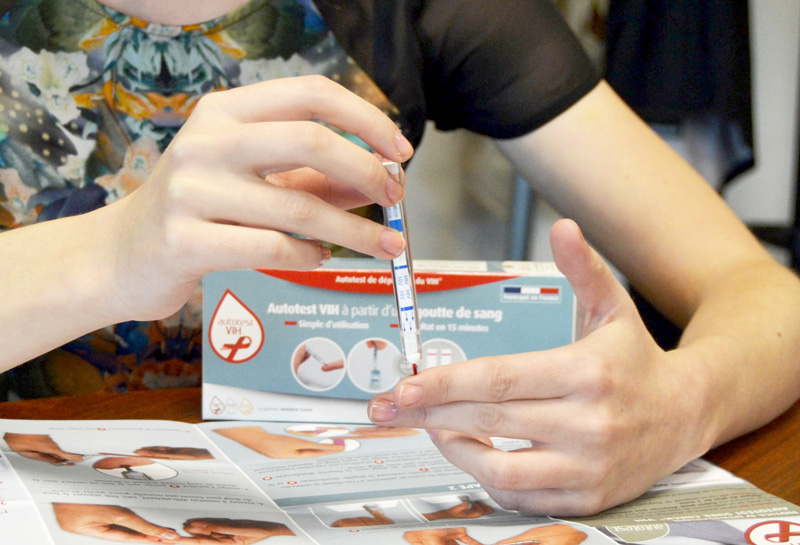
There is currently no vaccine to prevent HIV infection. However, treatments exist for an infected individual that considerably reduce the risk of transmission.
autotest VIH® can serve as a complement to conventional testing services (3).
autotest VIH® is intended to provide individuals with a practical and confidential way to check their HIV status following a possible exposure to HIV that occurred more than 3 months ago.
In the event of a positive result, the test makes it possible for a person to seek medical care and benefit from treatment after having a confirmatory lab test. If HIV treatment is started earlier, life expectancy can be similar to the general population. In fact, the mortality of men infected with HIV and on antiretroviral therapy for more than three years is comparable to the mortality of men in the general population(4).
A negative result means that a person is probably not infected with HIV and can feel confident about his/her HIV status if the the most recent risk of exposure occurred at least 3 months ago.
(3) File « autotests de dépistage de l’infection par le VIH », Haute Autorité de Santé. March 2015.
(4) Prise en charge médicale des personnes infectées par le VIH, Pr. Patrick Yeni. Specialists, 2010. Page 52.
autotest VIH® is a blood test based on an immunochromatographic assay.
autotest VIH® does not require materials or equipment other than those included in the test kit. autotest VIH® can be used in private, at home.
With a drop of blood taken from the tip of the finger, autotest VIH® is able to highlight the presence of anti-HIV-1 and/or anti-HIV-2 antibodies.
autotest VIH® is available for sale in all pharmacies across France (and on their websites) and can be obtained without a medical prescription.
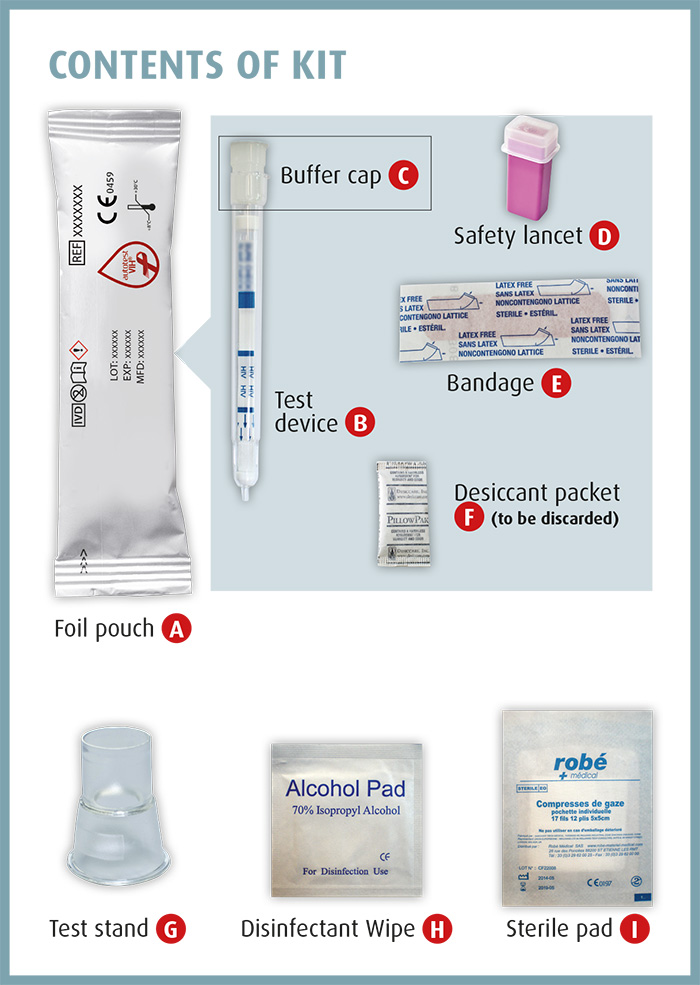
Speak to your pharmacist for more information. Every box contains:
- illustrated Instructions for use,
- a safety lancet to obtain a drop of blood,
- a test device with integrated sampling device that highlights whether anti-HIV-1 and/or anti-HIV-2 antibodies are present,
- a bandage.
It’s easy to get and read the result when using the autotest VIH® test. The test result appears as a line in just 15 minutes. If you have any doubts about the result, consult your doctor.

Packaging: single-use kit
Marqué CE 0459 (organisme notifié français LNE/G-MED)
Storage: between +8 and +30°C. Keep away from sunlight.
Type of sample: 2.5 microliters of capillary blood
Sensitivity (5): 100% of HIV-positive individuals obtained a correct result with this test.
Specificity(5): 99.8% of HIV-negative individuals obtained a correct result with this test.
Reliability: a practicability study of the handling of this test by laypeople showed that over 99.2% of participants obtained an interpretable result and over 98.1% correctly interpreted the result. Positive results were interpreted correctly in 100% of cases.
Interference: no significant interference has been observed upon examination of specimens that contain substances or that present medical conditions with the potential to affect the results of this test.
The window period (seroconversion) of the autotest VIH® test can be as long as three months meaning that HIV infections that occurred within the past three months might not be detected by this test.
(5) Studies of 503 people (sensitivity) and 2051 people (specificity) from the United States and the European Unio.


In relation to other types of testing, where does the autotest VIH® self-test fit in?
autotest VIH® is a rapid diagnostic orientation test. It is described as a unitary, subjective visual reading test that is easy to use and quickly provides a result (in under 20 minutes). It must be used with a sample of freshly collected capillary blood. Rapid tests are now able to detect both HIV-1 and HIV-2 antibodies. Some healthcare professionals and trained staff are able to use rapid tests in the course of their work. A negative result cannot be considered conclusive if the most recent risk of exposure to HIV occurred within the past 3 months. A positive result obtained using a rapid test must be confirmed by a laboratory test (4th generation Elisa test).
Who should do an HIV test and how often ?
Anyone who has reason to believe they may have been exposed to a risk of HIV infection should get tested. Getting tested is the only way to know whether you are HIV-positive.
Moreover, recommendations on HIV testing in France made in 2009 by the Haute Autorité de Santé (HAS) state that all members of the general population from the ages of 15 to 70 years should be offered an HIV test at least once in their lifetime regardless of risk of exposure to infection.
Certain groups of people are more at risk of exposure to HIV because they come from a region with high prevalence or because of practices that can put them at risk of infection. Individuals from the following groups should get tested on a regular basis:
- men who have sex with men (MSM);
- heterosexuals who have had more than one sexual partner in the past 12 months;
- people from French departments in the Americas;
- people who use injection drugs;
- people from regions where the prevalence of HIV is high, in particular Sub-Saharan Africa and the Caribbean;
- people who engage in sex work;
- people whose partners are HIV-positive.
The following individuals are advised to get tested at least once a year:
- MSM who have multiple sex partners;
- people who use injection drugs;
- people from Sub-Saharan Africa or the Caribbean who have multiple sex partners.
HIV testing should always be offered, in lab, in the following situations regardless of population:
- suspicion or diagnosis of an STI or hepatitis B or C;
- suspicion or diagnosis of tuberculosis;
- when planning or attempting to get pregnant;
- voluntary interruption of pregnancy;
- prescribing contraceptives for the first time;
- sexual assault;
- incarceration;
- in the event of signs that suggest the presence of an HIV infection.
It’s important to note that if a risk of exposure happened in the past 48 hours, a person should immediately go to a hospital emergency room for a consultation and possible prescription for post-exposure prophylaxis treatment (PEP).
Starting at what age can the autotest VIH® test be used?
A minor can use an autotest VIH® test without parental consent.
autotest VIH® should not be used by children younger than 18 months. Whether they are infected or not, all infants whose mothers are HIV-positive are also “HIV-positive” at birth due to a passive transfer of maternal IgG antibodies through the placenta. Regardless of the HIV-status of the child, a baby’s blood serum remains positive until these maternal antibodies disappear (in approximately 15 to 18 months). If the child is not infected, the blood serum becomes negative after this period. It will remain positive if the child is infected.
What are the technical features that characterize the test?
Packaging: single-use kit
Contents of kit: 1 package insert with instructions for use, 1 test stand, 1 sterile pad, 1 disinfectant wipe, 1 foil pouch containing 1 test device, 1 buffer cap, 1 safety lancet, 1 bandage.
Storage: 8 to 30°C
Sample type: capillary blood
Sensitivity: 100 %(*)
Specificity: 99,8 %(4)
Test principle: immunochromatographic assay that detects antibodies in human blood produced after infection with HIV (anti HIV-1 and anti HIV-2 antibodies)
*Studies of 503 people (sensitivity) and 2051 people (specificity) from the United States and the European Union. .
How reliable are HIV self-tests?
No HIV self-test is 100% reliable. False positive results (a specimen known to be negative for the target marker and mistakenly classified as positive by the test) or false negative results (a specimen known to be positive for the target marker and mistakenly classified as negative by the test) are possible. Failure to store as directed or to respect the limits of use could cause the test result to be incorrect.
In comparison to lab tests (Elisa – 4th generation), HIV self-tests are less sensitive to detecting new infections (infection occurred less than 3 month). In fact, different markers appear successively during HIV infection. According to the target marker and the method used, delays of first positivities are different. Negativity of autotest VIH® can only be certified after a precautionary period of 3 months(*).
Other tests exist but are not allowed in France, including oral HIV self-tests.
The window period for the autotest VIH® test (referring to the period of time required for HIV antibodies to develop in sufficient quantity to become detectable by the test) can be as long as three months(5). Therefore, a negative result can only be considered reliable if there has been no risk of exposure to HIV within the past 3 months.
A practicability study of the use of the autotest VIH® test by laypersons has shown that more than 99.2% of participants correctly used the self-test and succeeded to obtain an interpretable result and more than 98.1% self-tests are correctly interpreted. 100% of positive self-tests are correctly interpreted(**).
*Les TROD – tests rapides d’orientation diagnostique de l’infection à VIH, Dossier de synthèse documentaire bibliographique, Le CRIPS, septembre 2013
**Excellente praticabilité de l’Autotest Santé SURE CHECK® VIH sur sang capillaire par une population de profanes concernée par le VIH. S. Karon et al. Octobre 2014.
Is autotest VIH® capable of detecting both HIV-1 and HIV-2?
Yes, because autotest VIH® is able to detect both HIV-1 and HIV-2 antibodies in the blood.
In France, where do you go to get an autotest VIH® test?
autotest VIH®, an in vitro diagnostic test with the CE Marking, is only available in pharmacies and can be obtained without a medical prescription. The self-test can be obtained over the counter or on the pharmacy’s website. A list of pharmacy websites licensed for the online sale of medication can be found at: http://www.ordre.pharmacien.fr/Le-patient/Vente-de-medicaments-sur-Internet-en- France
Is the cost of purchasing an autotest VIH® test covered by Social Security?
At the moment, autotest VIH® is not covered by Social Security and individuals who use the test must assume its cost. autotest VIH® is only available in pharmacies (or on their websites) and can be obtained without a medical prescription.
How long do I have to wait after a risk of exposure to HIV before my autotest VIH® result can be considered reliable?
An HIV infection that has occurred as a result of high-risk practices (unprotected sex or condom failure during sex with a partner who is HIV-positive or whose HIV status is unknown, sharing of injection equipment) or accidental exposure (condom rupture, blood contact, etc.) within the past 3 months will not be detected by autotest VIH®. In such cases, a false negative result is possible and it is strongly recommended that you get tested with a 4th generation Elisa test if risk-taking occured at least 6 weeks ago at a Centre de Dépistage Anonyme et Gratuit (CDAG - free, anonymous testing centre); at a Centre d'information, de dépistage et de diagnostic des infections sexuellement transmissibles (CIDDIST - centre for information, testing, and diagnosis of sexually transmitted infections); or at a lab.
After the 3-month window period, autotest VIH® is considered reliable for detecting an HIV infection.
If a risk of exposure happened in the past 48 hours, a person should immediately go to a hospital emergency room for a consultation and possible prescription for post-exposure prophylaxis treatment (PEP).
What are the optimal conditions for using the autotest VIH® test?
or the result to be reliable, all of the directions included in the Instructions for Use should be carefully followed.
It is not necessary to have fasted before using the autotest VIH® test. The test can be used at any time of the day.
Good lighting is required in order to perform the test and read the result.
Use of the autotest VIH® test should not be taken lightly. Individuals who use the test need to be fully informed. The autotest VIH® test must only be used by person making a free and independent choice to do so. It is important to remember that no one should be forced to use the autotest VIH® test. All medical tests require the free and informed consent of the person being tested.
Before doing an autotest VIH® test, it is important to think about what you will do when you get the result, whether positive or negative. Using the autotest VIH® test is clearly different from getting tested by a healthcare professional who available to give advice and support and facilitate access to a confirmatory lab test.
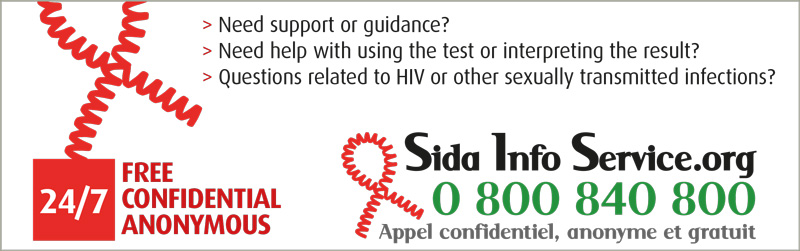
Information and advice can be obtained by speaking to a pharmacist or by calling the toll-free Sida Info Service number (0 800 840 800, 24/7, all calls are free and anonymous). It is also possible to contact a CDAG, a CIDDIST (or CeGIDD), or an AIDS service organization for immediate support.
After opening the foil pouch containing the test device, how long can I wait before using the autotest VIH® test?
The autotest VIH® test must be used as soon as you open the foil pouch. Moreover, the storage information that appears on the packaging and in the Instructions for Use is valid up to the expiry date only if the test remains sealed in its original foil pouch.
Can I use an autotest VIH® test if it has passed the expiry date printed on the packaging?
No HIV self-test should ever be used used if the expiry date has passed. The performance of the autotest VIH® test is only valid until the expiry date printed on the packaging.
How can I be sure that I have handled the test properly and that there is no error that has affected the result?
The test kit must be stored and the test must be used in accordance with the conditions specified on the autotest VIH® packaging.
During the time that the test takes to develop, a coloured line must appear (the “control line”). If the control line does not appear, this means the test was used incorrectly or did not work and the result is inconclusive. You will need to do another autotest VIH®.
It is important to read the test result within the time period specified in the Instructions for Use (between 15 and 20 minutes). A result may be false if it is read before or after this period of time.
What can I do if I have problems when using an autotest VIH® test?
If you have difficulties using the autotest VIH® test once you have read the Instructions for Use, call the toll-free Sida Info Service number (0 800 840 800, 24/7 free and anonymous call) or speak to your pharmacist for advice. It is also possible to contact a CDAG, a CIDDIST (or CeGIDD), or an AIDS service organization for immediate support.
If you are unsure whether you are using an autotest VIH® test properly, you are advised to start again with another test kit or go to a testing centre to have a 4th generation Elisa test.
I just bought my autotest VIH®, do I need additional materials or equipment?
Except for a timing device (watch, clock, or other timer), everything is provided. Prior to using the autotest VIH® test, be sure to have a timepiece conveniently at hand to keep track of the test development time.
Can the same autotest VIH® test be used more than once?
No, the autotest VIH® test is for single-use only, and for use by only by one person. It is not possible to use the same test more than once or for it to be used by more than one person. All of the contents of the test kit are for single-use only.
When the test is finished, what should I do with my used autotest VIH®?
The safety lancet in the kit is secured, the needle is retractable. Nevertheless in France, the lancet has to be returned to the pharmacy and eliminated in the yellow boxes given by the pharmacist (more information on dastri.fr). Other components can be eliminated with household waste.
What should I do if my test result is inconclusive?
If no line appears or if the control line is missing, you should either do another autotest VIH® using a new test kit purchased from a pharmacy or go to a lab, a CDAG, or a CIDDIST (or CeGIDD) for a 4th generation Elisa test.
What does does it mean if I get a positive result? What should I do?
The autotest VIH® test result is positive if two pink or red lines (one control line and one test line) appear on the self-test after 15 minutes.
Given limits to the reliability of the autotest VIH® test, a positive result does not necessarily mean that a person is infected with HIV.
All positive autotest VIH® test results must be verified by having a confirmatory 4th generation Elisa test at a CDAG, a CIDDIST (or CeGIDD), or a lab.
If your self-test result is positive, it is essential to consult your family doctor or go to CDAG/CIDDIST (or CeGIDD) that provides care and treatment for HIV-positive people.
For confirmed cases of HIV infection, starting treatment as early as possible is very important.
For questions regarding a positive HIV self-test result, call Sida Info Service: 0 800 840 800, 24/7, all calls are free and anonymous.
What does does it mean if I get a negative result? What should I do ?
The autotest VIH® test result is negative if only one pink or red line (the control line) appears on the self-test after 15 minutes. If the result is negative and there have not been any at-risk practices or accidental risk of exposure within the past three months, this means that the person who used the test is not infected. It is not necessary to get a confirmatory lab test unless you think you made an error in performing the test or interpreted the test result incorrectly.
If the result is negative but you have had practices that put you at risk of exposure to HIV in the past 3 months, the test result is not considered to be reliable because of the window period. It is recommended that you have a 4th generation Elisa test at a CDAG, a CIDDIST (or CeGIDD), or a lab.
If a person gets a negative test result, this does not mean that his or her sexual partner or partners are uninfected with HIV.
For questions regarding a negative HIV self-test result or if you need support, call Sida Info Serivce: 0 800 840 800, 24/7, all calls are free and anonymous.
Can information about the autotest VIH® test be obtained by phone?
Sida Info Service can provide information about HIV and about the use and interpretation the autotest VIH® test (0 800 840 800, 24/7, all calls are free and anonymous). You can also speak to you pharmacist for advice or contact an AIDS service organization.
Where can I find a list and contact information for the various agencies that provide advice, support, medical care, and psychological counseling?
A list of the following types of organizations can be found on the Sida Info Service website www.sida-info-service.org:
- CDAG;
- CIDDIST;
- hospital HIV departments;
- PASS and other agencies that provide services to individuals in need;
- agencies set up by COREVIH;
- AIDS service organizations.
Information for Metropolitan France as well as for overseas departments (DOM) is provided.
Can autotest VIH® be used to test for other sexually transmitted infections or for viral hepatitis?
No, autotest VIH® can only be used to test for infection with HIV. It cannot be used to test for other sexually transmitted infections such as herpes, syphilis, chlamydia, gonorrhea or viral hepatitis.
Doing an HIV test implies that there has been a risk of exposure (unprotected sex, sharing injection equipment, having sex with a partner who is infected with an STI, etc.) that can lead to more than one type of infection. On its own, having an HIV test may not be enough.
It is important to go to an agency such as a CDAG or CIDDIST to get tested for other infections.
If the result of my HIV self-test is negative, does this mean can I stop using condoms?
No, a negative autotest VIH® result does not mean that condoms are no longer necessary.
In the case of a couple getting tested to know whether it is safe to stop using condoms, a negative autotest VIH® result is not enough. Getting information about contraception and getting tested for other STIs are also advised.
Both partners will need to get tested for HIV and other STIs. Getting the results for just one partner is not enough to prevent the transmission of HIV or other STI within the couple.
For couples who to stop using condoms, a time frame of sufficient length must be take into account.
Because of the window period (both for self-tests and for all 4th generation HIV tests), a negative result does not mean a person is not infected, but rather that the individual was not infected 3 months ago. If an infection occurred less than 3 months ago, the autotest VIH® result can be negative. The risk of transmitting HIV to another person is highest at the start of an infection.
Unprotected sex is risky for the transmission of other STIs. The risk of HIV transmission is also higher if a sexual partner is infected with another STI. STIs are often asymptomatic.
Can the fact that I am taking a medication have an effect on the autotest VIH® result?
An autotest VIH® result can be false negative for individuals who are infected with HIV, who are taking antiretroviral therapy, and whose viral load is undetectable. This can be explained by a decrease in the production of anti-HIV antibodies due to inhibition of viral replication by the antiretroviral therapy.
No other medications have been observed to have an affect on an autotest VIH® result.
Can I use the HIV self-test to monitor the effectiveness of my antiretroviral therapy?
No, autotest VIH® should not be used by individuals taking antiretroviral therapy to monitor the effectiveness of the treatment.
Could someone else be infected handling a used HIV self-test?
autotest VIH® is a blood test performed using a retractable safety lancet. If basic rules for good hygiene and the Instructions for Use are followed, the risk of infection is practically non-existent.
A negligible risk of infection is present if the person using the self-test is HIV-positive and another person handles the test and has a wound that comes directly in contact with the test.

- autotest VIH® must only be used with a fresh sample of capillary blood collected following the instructions as explained in this insert. DO NOT USE for serum or plasma specimens.
- Store the self-test in its original packaging in a cool, dry location between 8°C and 30°C. Keep away from sunlight
- autotest VIH® is for single-use only. DO NOT RE-USE.
- Do not open the foil pouch containing the self-test device until you are ready to perform the test.
- This self-test is not intended for use in the context of therapeutic follow-up with patients receiving antiretroviral therapy.
- Individuals who use this self-test should consult their doctor prior to making any medical decisions, regardless of whether the test result is negative or positive.
- False positive results (0.2% in studies of test specificity) or false negative results could be obtained in the following circumstances: exposure to HIV in the 3 months prior to using the test (window period), situations of advanced immunodeficiency or infection by a rare variant, and among HIV-positive people receiving antiretroviral therapy.
- Failure to store as directed or to respect the limits of use could cause the test result to be incorrect.
- Do not use the self-test if the packaging or foil pouch have been opened or damaged.
- Do not use if expiry date printed on the packaging has passed.
- If you have trouble understanding the package insert or instructions for use, please contact Sida Info Service immediately at 0 800 840 800 (24/7).
- In case of repeated inconclusive tests, please consult your doctor.
- Keep this self-test and the items that come with it away from children, the components included with autotest VIH® could be harmful if swallowed and could cause irritations.
- autotest VIH® is an additional form of HIV testing that can be used as a complement to other existing options. autotest VIH® is only able to detect HIV infection and cannot be used as a test for other sexually transmitted infections.
- AAZ-LMB expressly disclaims all liability for the use or distribution of autotest VIH® or any of its components, and for the consequences of inaccuracies or errors whether direct, indirect, incidental, or otherwise arising from any use of the autotest VIH® that fails to strictly follow the directions and limits of use as specified the applicable Instructions for Use.
Legal Information
Single-use in vitro diagnostic test with the CE Marking
Product denomination: autotest VIH® (ref: AS-VIH-001)
Purpose: autotest VIH® is intended for self-detection of HIV by a layperson in a private setting.
Correct use: this self-test is reliable for the detection of an HIV infection that occurred at least 3 months ago. In the event of repeated inconclusive results, consult your doctor.
Instructions: carefully read the Instructions for Use prior to using the test and consult your pharmacist if necessary.
Manufactured and distributed by AAZ-LMB 43 rue de Bellevue 92100 Boulogne-Billancourt
FRANCE
Warning: In the event of any doubts about a test result, please consult your doctor.
This diagnostic medical device is a regulated health product that, in accordance with current regulations, bears the CE Marking.